
The Story
TRUE ARTIS has raised ₹11.4 crore in a seed round led by Zeropearl VC, with participation from Eleven, the diversified business group of Medanta co-founder Sunil Sachdeva, and a group of angel investors.
The angel list includes Arjun Vaidya, Dhruv Joshi, Ambarish Gupta and Vivek Lohcheb, chief business officer at PhonePe, along with former senior executives from Airtel and OYO.
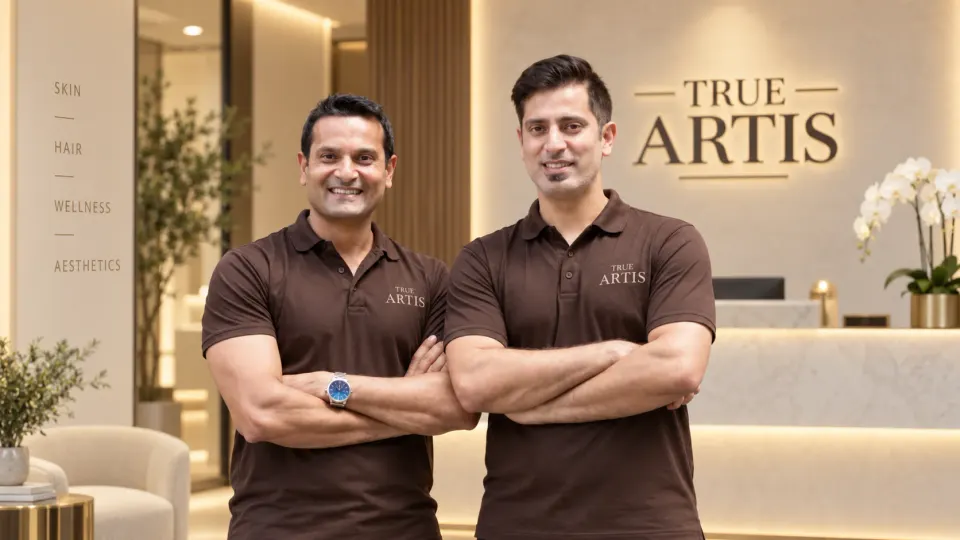
Ankit Joshi and Sandeep Upadhyay founded the company in 2025. It runs two centres, in Delhi and Gurgaon, fitted with operating theatres, surgical and medical equipment, dedicated recovery facilities, ICU backup and private patient suites. Around 20 plastic surgeons work across them on a full-time or visiting basis, which lets patients see several specialists through one platform.
Its services cover facial aesthetics, breast procedures, body contouring, hair restoration and non-surgical treatments, with an in-house technology platform managing the patient journey from enquiry and consultation through surgery and recovery.
The company says it has served more than 10,000 clients and completed over 400 surgeries in the past nine months, and reports a 98 percent client satisfaction rate. It also says its first centre has reached EBITDA break-even, with revenue growing at a double-digit rate month on month.
The money funds two new centres in Delhi NCR over the next six to eight months, alongside stronger surgical and recovery capabilities, a wider network of plastic and aesthetic surgeons, and further work on its technology and patient-care systems.
Why It Matters
The word doing the work in this announcement is not aesthetic. It is ICU.
India does not have a shortage of places offering cosmetic procedures. It has a shortage of places where something going wrong is survivable. Cosmetic work in this country has a long and documented history of being carried out by practitioners without plastic surgery training, in premises with no anaesthetist on hand and nothing to manage a complication if one develops. Plastic surgery associations have campaigned about it for years. For a patient considering body contouring or a breast procedure, the anxiety is not whether the result will be attractive. It is whether the building has the equipment to keep them alive if something happens.
That reframes what TRUE ARTIS is selling. Operating theatres, dedicated recovery facilities, ICU backup and hospital-grade protocols are not amenities that justify a premium. They are the product. Everything else, the technology platform, the private suites, the consultation journey, sits on top of a promise that this is a medically serious environment rather than a salon that has added surgery to its menu.
The second thing the model solves is supply, and it does so cleverly. Plastic surgeons are scarce and mostly work for themselves. Rather than trying to employ twenty of them, TRUE ARTIS built facilities they want to operate in and lets them come as visiting surgeons. The company owns the expensive, fixed part of the equation and rents access to the scarce, mobile part. It is close to how India's better private hospitals have always worked with consultants, applied to a category that has mostly been run out of standalone clinics.
Discretion is the quieter piece and it matters more than it appears. People having aesthetic surgery generally do not want to be seen having it. Private suites and separate recovery are a genuine reason to choose a dedicated centre over a general hospital where the waiting room is shared with everybody else's Tuesday.
The Strategic Read
Start with the two numbers that sit next to each other in the announcement: more than 10,000 clients, and just over 400 surgeries.
That is a conversion rate of about four percent, and it tells you what this business currently is. The overwhelming majority of people walking through the door are not having operations. They are having consultations, injectables, skin treatments, hair work, the non-surgical category that gets one line in the description. That is not a weakness. Non-surgical procedures are repeat purchases at modest tickets, surgery is a rare purchase at a large one, and a clinic needs the first to generate the flow from which the second occasionally emerges. But it does mean the revenue mix is very different from what an aesthetic surgery platform sounds like, and nobody has published what that mix is.
The EBITDA break-even claim needs the same care. It is genuinely uncommon for an Indian healthcare startup to disclose it at all, and a single unit covering its running costs after nine months is a real result. What EBITDA break-even excludes is the capital that built the place, and in this business that is the dominant cost. An operating theatre, surgical equipment, recovery facilities and ICU backup are not fit-out items; they are the majority of the investment. So the first centre pays for its staff, rent and consumables. Whether it has begun to return what it cost to build is a different question, and the answer determines how many centres ₹11.4 crore actually funds.
Two more in six to eight months, on this round, implies something in the region of four to five crore per centre including working capital. That is plausible for a clinical facility of this specification, and it leaves very little margin for the first one running behind schedule.
The more interesting structural question is who the customer is, because there are two of them. Around 20 plastic surgeons work across TRUE ARTIS on a full-time or visiting basis. A company cannot simply hire twenty plastic surgeons; they are scarce, expensive and generally have their own practices. What it can do is build a theatre better equipped than most of them have access to and let them operate in it. Seen that way, the surgeons are being sold facility access and patient flow, and the patients are being sold safety and discretion. Both sides have to keep choosing it.
That is also where the competitive risk sits. A visiting surgeon who brings her own patients to your theatre can bring them somewhere else next year, and the relationship is not contractual in the way an employment arrangement is. Building loyalty on the supply side is the quieter half of this business and the harder one to capitalise.
What the company has going for it is that the category's central problem is not demand. Indian appetite for aesthetic procedures has grown steadily and is not in doubt. The problem is trust: cosmetic procedures in India have a persistent history of being performed by practitioners without plastic surgery qualifications, in premises without the equipment to handle a complication. Against that backdrop, ICU backup is not a luxury feature in a brochure. It is the entire proposition, and having a Medanta co-founder on the cap table is worth more as a signal about clinical standards than as capital.
For daily, sharp analysis of the biggest moves in the Indian business and startup ecosystem, follow StartupFox.