


The Story
Slayd has raised ₹1.5 crore in a pre-seed round led by ajvc, the early-stage fund founded by Aviral Bhatnagar. The round values the Gurugram company at around ₹16.66 crore post-money, which implies roughly nine percent dilution. The money funds team expansion and scaling its private label.
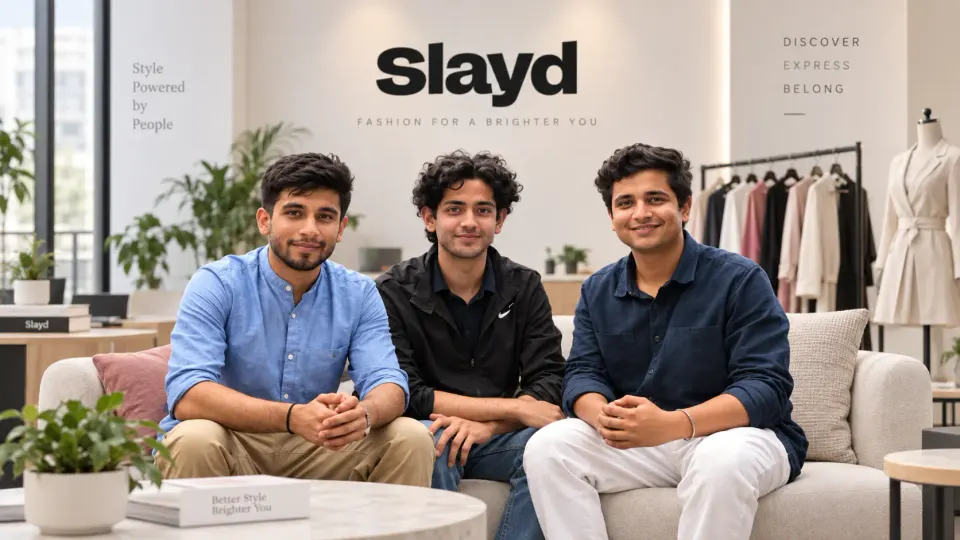
Sparsh Jain, Harsh Porwal and Kumar Prasang, all IIT Roorkee alumni, founded the company in 2025. It aggregates fashion products from more than 300 marketplaces and direct-to-consumer brands, adds around one lakh new products a month, and runs a proprietary model that scores products across more than eight signals to identify emerging trends. The results are organised into theme-based collections and personalised feeds so shoppers can browse across platforms in one place.
The company says it has passed 200,000 users with month-one retention above 40 percent, that power users average more than ten sessions a month, and that it currently flags over 2,000 products as emerging hotsellers.
It has also moved into manufacturing. Slayd Originals, its own label, launched in beta earlier this year and runs at around 1,000 orders a month. The company says its trend data identifies which styles to develop.
"India sees more than 1 lakh new apparel designs launched every month across hundreds of fragmented e-commerce platforms. Yet shoppers still have to navigate multiple platforms to discover what's actually trending. Slayd is building the discovery layer for this fragmented market," co-founder Sparsh Jain said.
Co-founder Harsh Porwal described the private label logic: identifying what shoppers want before building it, then controlling design and supply chain to deliver high-demand styles at better prices and more consistent quality.
Why It Matters
There is a pattern running through Indian consumer startups this month, and Slayd is the clearest example of it.
Discovery platforms do not make money. They do the expensive work of helping someone decide what to buy, and then the purchase happens on somebody else's checkout page. Affiliate commissions are thin, brands that pay for placement corrupt the recommendations that made the product useful, and the user leaves. It is a well-documented trap, and the way out of it is always the same: stop pointing at products and start owning them.
Firi, which raised three million dollars this week for curated beauty quick commerce, got there by building a discovery platform called Honestly first and then starting again with inventory attached. Slayd is doing the same thing without the restart, running the discovery product and the private label inside one company. The destination is identical. Only the route differs.
What makes Slayd's version interesting is the direction of information flow. Its private label is not a bolt-on revenue line; it is fed by the platform above it. Slayd watches one lakh new apparel designs appear every month across 300 sources and scores which ones are starting to move. It then manufactures the winners. That inverts how most clothing brands operate, which is to guess a season ahead, commit to fabric and cuts, and discover whether they were right when the stock either sells or gets marked down.
Inventory risk is the thing that kills fashion companies. Not competition, not customer acquisition, not brand. Unsold stock, bought on a guess, cleared below cost. A brand that commits to manufacturing only what it has already watched sell elsewhere is attacking the single largest cost of being wrong in this industry.
The founders are describing exactly this. Porwal's framing is that they can identify what shoppers want before building it, and controlling design and supply chain lets them deliver those styles at better prices. That is a supply chain argument dressed as a product one, and it is the right way round.
The Strategic Read
Slayd is now doing two things that will eventually pull against each other.
As a discovery platform, its value to users is neutrality. It surfaces what is genuinely gaining traction across 300 marketplaces, and shoppers trust the feed precisely because Slayd has no stake in which product they pick. As a private label owner, it has a stake in exactly that. Every order that goes to Slayd Originals is an order that does not go to one of the brands it aggregates, and the ranking algorithm that decides what a user sees is controlled by the company selling one of the options.
At 1,000 orders a month nobody will notice or care. The conflict is structural rather than immediate, and it grows precisely as the private label succeeds. It is the same tension every marketplace that has gone into own-brand has run into, and the ones that handled it badly lost the trust that made the discovery product work in the first place. Slayd will need an answer before Slayd Originals is large enough for the question to be asked.
The scale numbers should also be read carefully. Two hundred thousand users with 40 percent month-one retention is a decent result for a discovery app, and ten sessions a month from power users is genuine engagement. But engagement is the easy half of this category. Discovery platforms in Indian fashion have repeatedly attracted users cheaply and then failed to convert that attention into money, because the transaction happens somewhere else and the affiliate economics are thin. LimeRoad built a large discovery audience in women's fashion and ended up sold to V-Mart. Wooplr and Voonik both came at the same problem and are gone.
Which is why the private label is not a distraction from the business. It is the business, or at least the only version of it that has ever monetised. Slayd's own framing makes that clear: the discovery layer generates the demand signal, and the label captures the margin the signal identifies.
On that logic, this is a more defensible version of the pivot than most. Fashion's structural problem is inventory risk, and inventory risk is a forecasting problem. A company that can see which of one lakh new monthly designs are starting to move, across hundreds of platforms, before it commits to manufacturing anything, has a genuinely better starting position than a brand designing from intuition and a mood board. Whether that translates into sell-through depends on how fast it can go from signal to shelf, and fashion manufacturing cycles are not fast.
The honest caveat is the size. ₹1.5 crore is about $160,000. Slayd Originals at 1,000 orders a month is a small business by any measure, and building a clothing label means buying stock, which is what this money will mostly become. This round buys enough runway to prove the loop works from signal to product to sale. It does not buy the scale that would make the loop matter.
For daily, sharp analysis of the biggest moves in the Indian business and startup ecosystem, follow StartupFox.